Global web icon
wikipedia.org
https://en.wikipedia.org/wiki/Frequency_modulation
Frequency modulation - Wikipedia
Frequency modulation and phase modulation are the two complementary principal methods of angle modulation; phase modulation is often used as an intermediate step to achieve frequency modulation. These methods contrast with amplitude modulation, in which the amplitude of the carrier wave varies, while the frequency and phase remain constant.
Global web icon
geeksforgeeks.org
https://www.geeksforgeeks.org/physics/frequency-mo…
Frequency Modulation - GeeksforGeeks
Frequency Modulation is a process of encoding information on one carrier wave by changing its frequency. The frequency of the carrier wave is changed according to the frequency of the modulating signal. Frequency modulation is used for broadcasting and radio communication.
Global web icon
electronicscoach.com
https://electronicscoach.com/frequency-modulation.…
Frequency Modulation (FM) - Electronics Coach
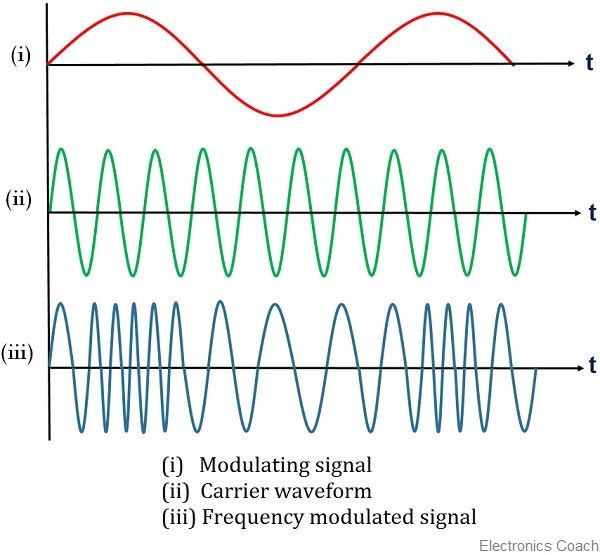
Definition: A category of angle modulation in which the frequency of the carrier wave is changed according to the amplitude of the message signal is known as frequency modulation. It is abbreviated as FM and is a widely used analog modulation technique.
Global web icon
howengineeringworks.com
https://www.howengineeringworks.com/questions/what…
What is modulation? - howengineeringworks.com
What is modulation? Short Answer Modulation is the process of adding information, such as voice, music, or data, to a high-frequency carrier wave so that it can be transmitted over long distances. The information signal alone has low frequency and cannot travel far, so it is combined with a carrier wave for efficient transmission.
Global web icon
patsnap.com
https://eureka.patsnap.com/article/what-is-frequen…
What is Frequency Modulation and How is it Used in Communication?
Frequency Modulation, commonly known as FM, is a technique used to encode information on a carrier wave by varying its frequency. This modulation method is crucial in transmitting data, particularly in radio broadcasting, telecommunications, and various communication technologies.
Global web icon
rfpage.com
https://www.rfpage.com/frequency-modulation/
What is Frequency Modulation (FM) - RF Page
Unlike AM, which uses modulation to vary the amplitude of the carrier wave, Frequency Modulation (FM) involves a variation of the frequency of the carrier signal. In simpler words: A high-frequency signal, the carrier wave (a vast majority of the time it is in a range of MHz).
Global web icon
audiodramaproduction.com
https://audiodramaproduction.com/radio-broadcastin…
Frequency Modulation - Definition & Detailed Explanation - Radio ...
Frequency Modulation (FM) is a method of encoding information on a carrier wave by varying the frequency of the wave. In FM, the frequency of the carrier wave is modulated in accordance with the amplitude of the input signal. This modulation technique is widely used in radio broadcasting, telecommunications, and radar systems.
Global web icon
testbook.com
https://testbook.com/physics/frequency-modulation
Understanding Frequency Modulation: Mechanism, Applications, Equations ...
You've probably encountered the term Frequency Modulation (FM) in your day-to-day life, especially if you're familiar with radio communication and broadcasting. But have you ever paused to ponder about what it really means or the technology behind it?
Global web icon
tavtechsolutions.com
https://tavtechsolutions.com/glossary/frequency-mo…
Frequency Modulation: How It Works and Applications
Frequency Modulation (FM) is a method of encoding information in a carrier wave by varying its frequency. It is one of the two primary methods of analog modulation, the other being Amplitude Modulation (AM). In FM, the frequency of the carrier wave changes in proportion to the amplitude of the input signal, while its amplitude remains constant.
Global web icon
radiodesigngroup.com
https://www.radiodesigngroup.com/blog/methods-of-t…
Methods of Transmission: FM or Frequency Modulation — RDGI
In its simplest form, the frequency of the transmitter is controlled by the modulating signal. For example, as the voltage of the modulating signal rises, the transmitter’s frequency increases. As the voltage falls, the frequency decreases. A common variation of FM is PM or phase modulation.